
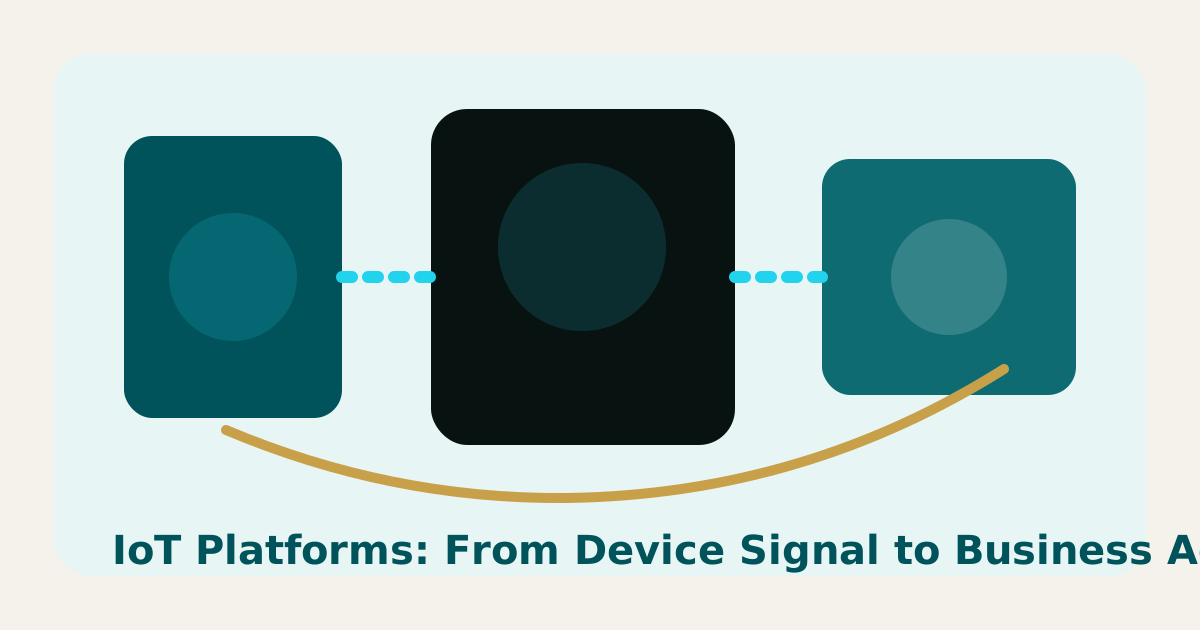
IoT Platforms: From Device Signal to Business Action
Why industrial IoT projects fail in the handoff between telemetry collection and business workflows, and how to avoid that gap.
Kabir Hossain
Founder, Chainweb Solutions
Turning IoT signals into operational decisions
Many IoT programs reach the same plateau. Devices are connected, dashboards are live, and data volume looks impressive, yet day-to-day operations barely change.
That usually happens because the system was built for visibility, not action.
Telemetry creates value only when it changes decisions: what gets repaired first, where risk is rising, when to escalate, and how teams respond in real time.
Data needs a clear path to action
Ingestion is only step one. Useful IoT architecture maps signal to workflow.
The teams that execute well usually define:
- which events require immediate action
- which thresholds reduce alert noise
- who owns each response path
- where context should appear for operators
Without this, the platform becomes an expensive reporting layer.
Field reality punishes fragile assumptions
Industrial environments are noisy. Connectivity drops, hardware drifts, and data arrives out of order. Systems designed for perfect conditions fail when reliability matters most.
Resilient implementations normally include:
- edge buffering for intermittent links
- device health observability
- replay-safe event handling
- strong out-of-order processing
These are the details that keep downstream decisions trustworthy.
Operator workflow should drive product design
A common mistake is designing from a dashboard-first perspective while ignoring how field teams actually work.
Adoption improves when alerts and context show up in existing operational tools, not in yet another isolated interface.
If action requires too many clicks or context switches, response quality drops.
Practical architecture pattern
For most logistics and industrial use cases, a layered model is easier to maintain:
- Edge layer for local validation and buffering.
- Ingestion layer for schema checks and normalization.
- Decision layer for thresholding and anomaly routing.
- Action layer that writes into ticketing, ERP, or maintenance tools.
This structure keeps responsibilities clear and makes incident debugging much faster.
Roll out in controlled slices
Trying to connect every device class and every workflow in v1 usually creates overload.
A better path is:
- start with one high-impact use case and one KPI
- prove reliability under real operating conditions
- expand only after operators trust the output
Small wins build credibility. Credibility enables scale.
Why this content gets referenced
IoT decision-makers share practical implementation guidance, not abstract future trends.
Topics like offline handling, threshold design, and telemetry normalization are naturally citeable because teams face them every day.
If your blog captures those real lessons, it becomes a trust asset.
Final takeaway
IoT success is not measured by how much you can collect. It is measured by how confidently teams can act.
Design for operational reality, and signal becomes business value.
Related articles
Continue with articles on similar topics.