

Context Engineering Is a System Design Problem, Not a Prompting Skill
Why production AI agents drift and break, and how treating context as a versioned, owned, environment-tagged engineering artifact changes that.
Kabir Hossain
Founder, Chainweb Solutions
Context engineering is a system design problem, not a prompting skill
Most teams discover this the same way. An agent works well in testing. Behavior drifts in production. Someone adjusts the system prompt. It helps for a week, then stops helping.
The cycle repeats because the underlying problem is not the prompt. It is that nobody has defined what context is, who owns it, or how it changes.
What context engineering actually means
Context is everything the model sees before it responds: instructions, memory, retrieved documents, conversation history, tool definitions, and examples.
Most practitioners think about this at the prompt level. That works for prototypes. It does not work for systems with multiple agents, multiple environments, and multiple teams.
Context engineering treats these inputs as first-class software artifacts with the same lifecycle as application code: versioning, ownership, environment promotion, and rollback.
The three layers that matter in production
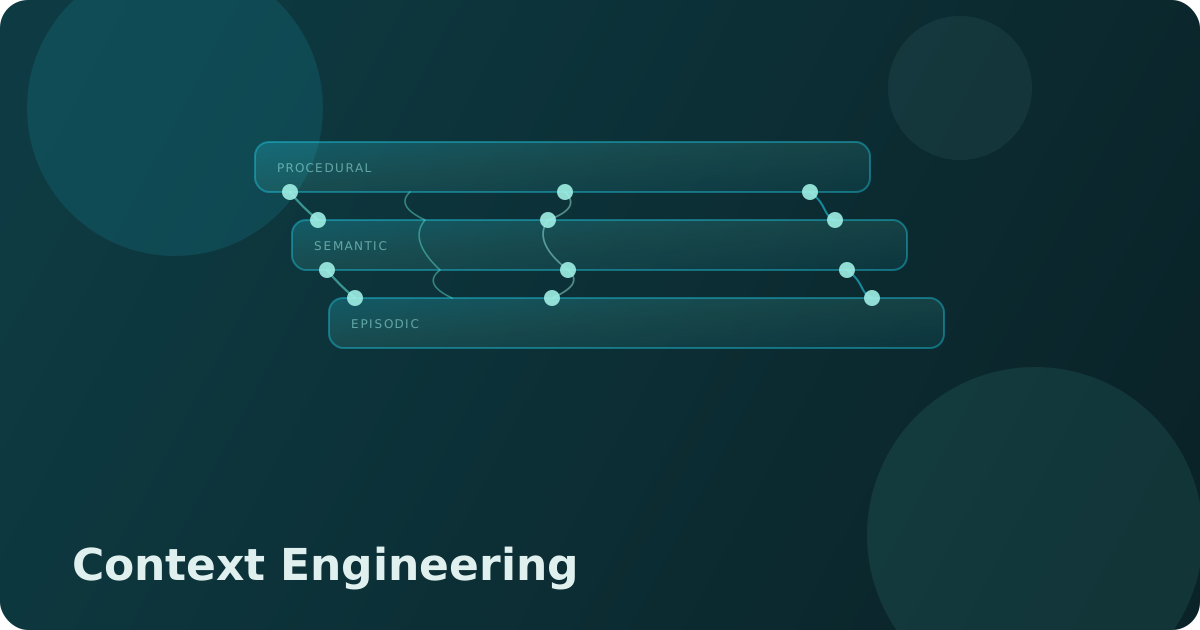
Production agent systems have at least three distinct context layers, and each one fails in different ways.
Procedural context defines how the agent behaves: its role, capabilities, constraints, and output format. This is what most people call the system prompt. In a multi-agent system, each agent has its own procedural context, and inconsistencies between them cause silent coordination failures.
Semantic context is retrieved from external knowledge: documentation, product data, customer records. The retrieval quality determines whether the agent answers from relevant information or hallucinates confidently. Chunking strategy, metadata, and freshness belong here.
Episodic context is working memory: the current conversation, recent tool results, decisions made in prior turns. Most agent failures in long-running tasks come from episodic context that grows stale, gets truncated badly, or contains conflicting state.
Teams that treat all three as a single system prompt end up with a fragile blob that nobody fully understands and nobody wants to touch.
Environment parity is the gap that causes most incidents
Application engineers learned long ago not to test against production databases. Context engineering has the same problem.
An agent tested against a specific knowledge snapshot, with specific tool definitions, using a specific model version, will behave differently when any of those change. Without environment tagging, the team cannot tell whether a behavior regression came from a model update, a retrieval change, or an instructions edit.
Practical controls that close this gap:
- tag context artifacts with the environment they belong to (dev, staging, prod)
- version instructions explicitly with meaningful change notes, not just timestamps
- pin model versions at each environment boundary before promoting
- run regression traces against a fixed evaluation set when any context layer changes
None of this requires new tooling. It requires treating context with the same discipline as infrastructure configuration.
Ownership is the organizational problem context engineering exposes
Ask who owns the system prompt on most production agents. The answer is usually unclear.
Someone from the product team wrote the first version. An engineer cleaned it up. A customer success manager added a tone note. The latest change was made by whoever was debugging last week.
When the agent behaves unexpectedly, nobody knows which edit caused it, and nobody wants to roll back because the full history is not tracked.
Effective ownership usually splits along the context layers:
- Procedural context — a product or domain owner who defines goals, constraints, and tone
- Semantic context — the team responsible for the knowledge source and its freshness
- Episodic context — engineering, since working memory behavior is a runtime architectural decision
These can be the same person in a small team. What matters is that accountability exists.
When context gets complex, compression strategy matters
At scale, context windows fill faster than expected.
Long conversation histories. Multiple tool results. Retrieved documents that are partially relevant. Verbose step-by-step reasoning chains. Each agent turn adds more weight to the context the next turn inherits.
Teams that do not design compression strategy explicitly end up with one of two failure modes: important context gets truncated silently, or the window fills so quickly that useful retrieval becomes impossible.
Practical compression choices to make explicitly:
- summarize intermediate reasoning chains rather than appending raw output
- filter retrieved documents by confidence score before insertion
- set a rolling summary policy for episodic context past a defined depth
- separate system identity instructions from retrieval context so core behavior survives truncation
This is a design decision, not a tuning parameter. Make it before the agent reaches production.
Final takeaway
Context engineering is where AI system quality is decided. Models are improving faster than teams can keep up with, but the engineering discipline around the inputs those models receive is still immature in most organizations.
When context has clear owners, defined layers, environment parity, and compression strategy, agents become reliable systems instead of experimental tools. That is the standard production AI deserves.
Related articles
Continue with articles on similar topics.